ISO 15118: The standard for intelligent communication between EVs and charging stations
ISO 15118 is an international standard that defines the communication between electric vehicles and charging stations.
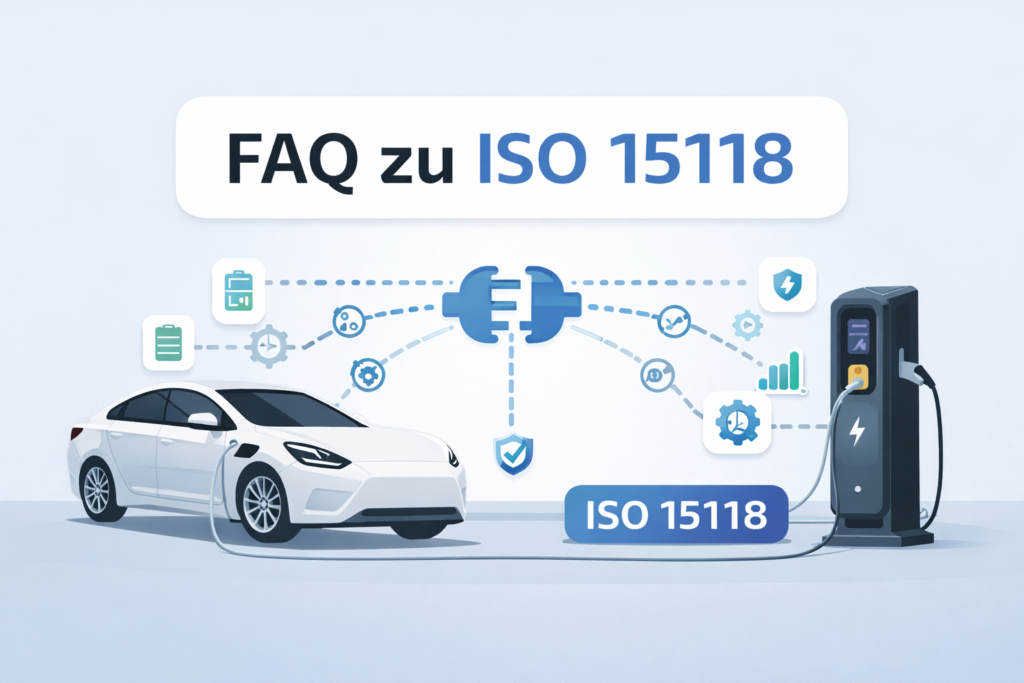
ISO 15118 is an international standard that defines the communication between electric vehicles and charging stations. While previous charging standards such as IEC 61851 mainly regulate the physical connection and basic safety aspects, ISO 15118 goes significantly further: The standard enables a bidirectional, encrypted data exchange between the vehicle and charging infrastructure.
Communication takes place via the charging cable itself using Power Line Communication (PLC), so no additional data connection is required. The vehicle and the charging station exchange not only information about charging power and battery status, but can also transmit complex data such as certificates, tariff models, charging schedules, and energy flow directions.
The standard was jointly developed by the International Organization for Standardization (ISO) and the International Electrotechnical Commission (IEC) and is continuously being developed further. The first version (ISO 15118-1) was published in 2013, and since then several parts and versions have been added covering different aspects of communication.
How does ISO 15118 work?
ISO 15118 uses Power Line Communication (PLC) to transmit data directly via the charging cable between the vehicle and the charging station. Both systems exchange information about state of charge, power, and authentication to control the charging process automatically.
Core Functions of ISO 15118
**Plug&Charge: Automatic Authentication** One of the most revolutionary features of ISO 15118 is Plug&Charge. Instead of having to authenticate at the charging station with an RFID card, app, or credit card, the vehicle automatically identifies itself when the charging cable is plugged in. The entire process runs in the background: The vehicle transmits a digital certificate to the charging station, which checks the authorization with the backend system, and the charging process starts automatically.
After the charging process is completed, billing also occurs automatically via the stored payment method. For users, this means maximum convenience, no registration at every new charging station, and no more various charging cards. Plug&Charge works across manufacturers, so a BMW can charge at a charging station just as seamlessly as a Tesla or a VW.
Security is ensured by a Public Key Infrastructure (PKI) and encrypted certificates. Each vehicle receives a unique certificate from the manufacturer, which is regularly updated and cannot be forged. The charging station verifies this certificate in real-time before authorizing the charging process.
Smart Charging Features
ISO 15118 is the technical foundation for advanced Smart Charging. The standard allows the exchange of detailed information between the vehicle and charging station, which is necessary for intelligent optimization:
**Battery Status and Charging Capacity**: The vehicle tells the charging station exactly how much energy the battery can still absorb, what temperature it is at, and what the current state of charge is. This information allows for a battery-friendly charging strategy that extends the life of the expensive battery.
**Dynamic Charging Schedules**: The vehicle can tell the charging station by when it needs to be charged and what target state of charge is desired. The higher-level charge management or energy management system then creates an optimized charging schedule that takes electricity prices, grid utilization, and available renewable energies into account. The charging station executes this plan and can adjust it dynamically during the charging process if conditions change.
**Energy Management**: For wallboxes in private or commercial settings, ISO 15118 enables integration into higher-level energy management systems. The charging station can inform the vehicle that there is currently a lot of PV surplus available and charging power can be increased, or conversely request a reduction during grid bottlenecks.
**Bidirectional Charging (V2G/V2H)**: Arguably the most forward-looking function of ISO 15118 is the support for bidirectional energy flows. Vehicle-to-Grid (V2G) and Vehicle-to-Home (V2H) require that energy not only flows from the grid to the vehicle, but also the other way around. This requires complex communication that ISO 15118 enables.
The vehicle can inform the charging station how much energy it can discharge at maximum, what minimum charge should remain in the battery, and at what times discharging is possible. The charging station then coordinates the energy flows with the charging system based on grid demand, electricity prices, and user preferences. With V2H, the electric car can supply its own home with backup power during outages or serve as a buffer storage during times of high electricity prices.
For grid stability, millions of electric vehicles are enormously valuable as flexible storage. ISO 15118 creates the technical prerequisite for this vision to become reality.
ISO 15118-2 vs. ISO 15118-20: The Evolution of the Standard
The ISO 15118 standard exists in different versions, with ISO 15118-2 and the newer ISO 15118-20 being the most important ones.
**ISO 15118-2** is the first complete implementation of the standard and has been available since 2014. It focuses on AC and DC charging with the Combined Charging System (CCS) and already enables Plug&Charge as well as basic Smart Charging functions. Communication is based on XML messages and already supports bidirectional charging, albeit with certain flexibility limitations.
**ISO 15118-20** (also known as the second generation) was published in 2022 and brings significant improvements. The new standard is charging system-independent and supports CHAdeMO, GB/T (Chinese standard), and future charging technologies in addition to CCS. Communication has been made more efficient and now uses more compact data formats in addition to XML.
Particularly relevant for Smart Charging is the extended support for dynamic tariff models and improved V2G functions. ISO 15118-20 allows multiple parties (grid operators, electricity traders, aggregators) to communicate with the vehicle simultaneously and set optimization requirements. The vehicle can prioritize these requirements and make decisions autonomously.
The security architecture was also improved: Certificates can now be updated more easily, and encryption complies with the latest cybersecurity standards. This is particularly important because as connectivity increases, the attack surface for cyber attacks also grows.
Why ISO 15118 is Indispensable for Smart Charging
Without ISO 15118, Smart Charging remains limited to simple, static rules. The standard is essential for the advancement of intelligent charging for several reasons:
**Standardized Communication**: Before ISO 15118, different manufacturers used proprietary protocols, which severely limited interoperability. With ISO 15118, vehicles of all brands can communicate with charging stations from all manufacturers without requiring special adaptations. This is the basic prerequisite for a functioning, cross-manufacturer charging network.
**Real-Time Optimization**: Bidirectional communication makes it possible to adjust charging parameters in real time. If suddenly a lot of wind power is fed into the grid, the charging station can immediately tell the vehicle that now is a good time to charge. Conversely, at a low state of charge, the vehicle can signal that a minimum charge is required despite all optimization.
**User Convenience**: Plug&Charge eliminates one of the biggest hurdles for electromobility in public spaces: complicated authentication at various charging networks. This significantly improves the user experience and promotes the adoption of electric vehicles.
**Enabler for V2X**: Bidirectional charging is practically unfeasible without ISO 15118. The standard not only defines the technical communication but also the security protocols and billing mechanisms necessary for V2G and V2H. Only with a unified standard can the enormous potential of electric vehicles as grid storage be unlocked.
**Future-Proofing**: ISO 15118-20 is deliberately designed to be technology-neutral and can integrate future developments such as wireless charging, new battery technologies, or alternative charging systems. Investments in ISO 15118-compatible infrastructure are thus secured for the long term.
Implementation Status and Challenges
The implementation of ISO 15118 is progressing but is not yet complete across the board. In **vehicles**, many new models from premium manufacturers now support ISO 15118-2, including various models from Mercedes, BMW, Audi, Porsche, and Ford. Tesla has announced it will support the standard, but still largely uses proprietary solutions. Among volume manufacturers, implementation is at varying stages.
For **charging infrastructure**, the situation is similar: New DC fast-charging stations increasingly support ISO 15118. For AC wallboxes for the home segment, penetration is lower but growing. An obstacle is that many older charging stations cannot simply be upgraded to ISO 15118 via a software update, but require hardware changes.
**Challenges** exist primarily in the complexity of implementation. ISO 15118 is a comprehensive standard with many optional features, which can lead to interoperability problems if manufacturers implement different subsets. The industry is therefore working on test programs and certifications to ensure that different implementations are truly compatible.
Another issue is the **certificate infrastructure** for Plug&Charge. Trusted certification authorities must be established to issue and manage vehicle and charging station certificates. In Europe, the CharIN association coordinates these efforts with the Plug&Charge project, in which over 50 companies collaborate.
Outlook: The Future with ISO 15118
**Systems like [NeuraCharge](/) use ISO 15118 to optimize charging processes intelligently and control them automatically.**
The future of intelligent charging is closely linked to ISO 15118. With the increasing adoption of ISO 15118-20, Smart Charging functions will become significantly more mature and user-friendly. The seamless integration of electric vehicles into the energy system is becoming reality, and the vision of millions of mobile battery storage units contributing to grid stability is moving closer.
Particularly exciting is the combination with machine learning systems like NeuraCharge. ISO 15118 provides the data foundation and control options, while ML algorithms calculate the optimal charging schedules. The vehicle shares its parameters via ISO 15118, the ML system creates an optimal plan based on forecasts for electricity prices, usage behavior, and grid utilization, and this is communicated back to the vehicle via ISO 15118 and executed.
For companies with fleets, ISO 15118 will become the standard, as only in this way can complex charge management scenarios with many vehicles be implemented efficiently. Automatic authentication also considerably simplifies billing for company vehicles.
ISO 15118 is more than a technical standard, it is the key to the next evolutionary stage of electromobility. Investing in ISO 15118-compatible charging infrastructure pays off in the long term and creates the foundation for all future Smart Charging innovations.