What is Smart Charging? Intelligent Charging Explained Simply
Smart Charging is a technology for intelligently controlling the charging process of electric cars.
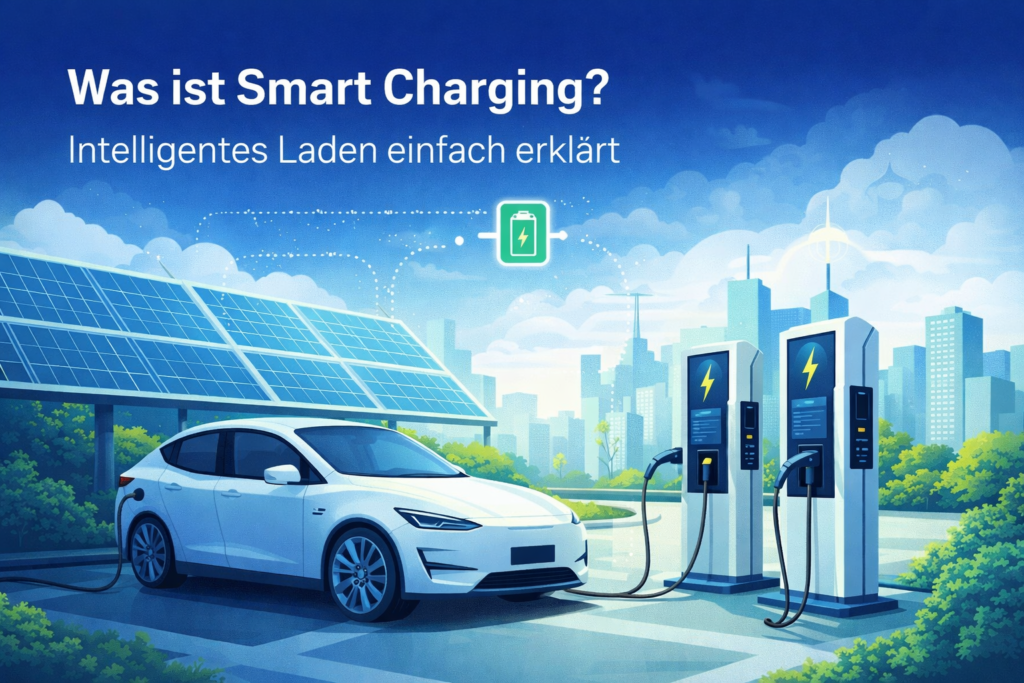
The advantages of Smart Charging at a glance:
lower electricity costs through optimized charging times
better utilization of PV surplus
avoidance of grid overload through load management
longer battery lifespan
In this article you will learn:
What Smart Charging is and how it works
What types of Smart Charging exist
How intelligent charging is used in everyday life
Why Smart Charging is crucial for the energy transition
Where Smart Charging stands today and which technologies are already available
Which technologies and trends will determine the future
What is Smart Charging? Definition and Functionality
Smart Charging refers to the intelligent control of the charging process of electric vehicles by automated systems. In contrast to conventional charging, where the vehicle is charged with maximum power until full battery capacity, Smart Charging takes into account various factors such as electricity prices, grid utilization, renewable energies, and individual user needs. The goal: to design an optimal charging process that makes sense both economically and ecologically.
The functionality is based on communication between the charging station, the vehicle, the energy or charging management system, and partially the power grid. Modern charging systems continuously collect data and dynamically adjust the charging power to current conditions. This flexibility makes the crucial difference compared to conventional charging.
Example Smart Charging at home: Intelligent charging in your own garage
In the private sector, Smart Charging offers particularly diverse possibilities. A typical scenario: You come home at 6 p.m. and connect your electric car to the wallbox. Instead of immediately charging at full power – which often happens exactly when the stove, washing machine, and other household appliances are also running – the system first analyzes various parameters.
The intelligent wallbox takes your specified departure time the next morning into account, checks the current electricity price, and detects whether your photovoltaic system is expected to generate a lot of solar power the next day. If you have a dynamic electricity tariff, the system automatically shifts the main charging process to the night hours when electricity prices on the exchange are low. At the same time, it ensures that your home connection is not overloaded by throttling the charging power when other devices currently need a lot of electricity.
Example Smart Charging at work: Load management in the company
At the workplace, Smart Charging shows its strengths primarily in load management. Companies with multiple charging stations face the challenge that the existing grid connection is limited. If all employees were to charge their vehicles at full power at the same time in the morning, an overload would occur.
An intelligent charging management system dynamically distributes the available power to all connected vehicles. Priority levels can be defined, for example for company vehicles that need to be ready for use again at noon, or for vehicles with a critical state of charge. The system continuously optimizes and ensures that all vehicles are charged on time without having to make costly expansions to the grid connection capacity. In addition, companies can benefit from tariff optimization and shift the charging process to cheaper electricity price phases.
Example Public Smart Charging: Flexible charging on the go
In public spaces, Smart Charging fulfills an important function for grid stability. Public charging stations can be integrated into the load management system of the local grid operator. In the event of an imminent grid overload, the charging power can be temporarily reduced.
At the same time, Smart Charging at public stations enables better use of renewable energies. For example, if a lot of wind power is available in the grid, charging prices can be dynamically lowered to create incentives for charging during this time window. For users, this means: those who are flexible and can leave their vehicle parked longer benefit from cheaper tariffs.
Smart Charging Types: Control and Optimization Options
Smart Charging includes various solutions and control types that can be used depending on the situation and priority. Modern systems often combine several of these approaches to achieve an optimal overall result.
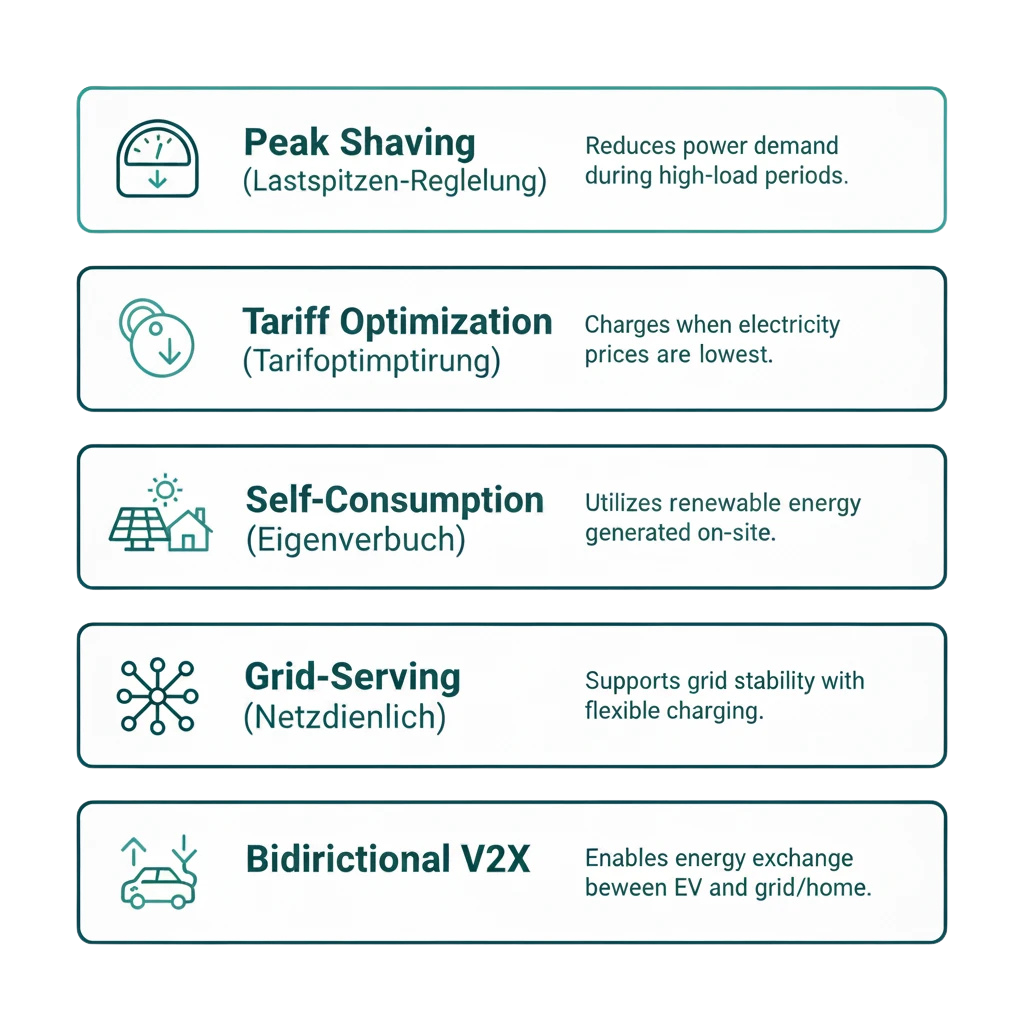
Control types in intelligent charging
**Peak Shaving** prevents overloading of the grid connection by adjusting the charging power in real time. For example, if the heat pump at home starts up or the production machines in the company start up, the system automatically throttles the charging power of the electric vehicle. As soon as more capacity is available again, the power is increased. This control is particularly important to avoid costly peak loads, which lead to increased base fees in many commercial tariffs.
**Economic Control** focuses on minimizing electricity costs. In connection with dynamic electricity tariffs based on the exchange electricity price, the system automatically shifts the charging process to the cheapest hours. Prices on the electricity exchange fluctuate considerably; they are particularly low at night and on windy days, while they rise significantly during peak load times. An intelligent charging system analyzes the price development and starts the charging process at the optimal time without the user having to intervene manually.
**Self-Consumption Control** maximizes the use of self-generated electricity, especially from photovoltaic systems. The system communicates with the home's energy management system and automatically increases the charging power when the PV system produces a surplus. On sunny days, the vehicle is primarily charged with solar power, while in the evening and night hours, only the necessary recharging from the grid takes place. This not only reduces electricity costs but also significantly improves the CO₂ footprint.
**Grid-Serving Control** serves to stabilize the entire power grid. Grid operators can externally influence the charging power via control signals to prevent local grid bottlenecks or to absorb surpluses of renewable energy. This form of Smart Charging is becoming increasingly important as more volatile renewable energies are integrated into the grid. Users who make their charging station available for grid-serving charging often receive financial incentives or reduced grid fees.
**Bidirectional Control (V2X)** is the most advanced form of Smart Charging. The electric vehicle acts not only as a consumer but also as a mobile power storage unit. With Vehicle-to-Home (V2H), the car can supply the home with electricity, for example during a power outage or in times of high electricity prices. With Vehicle-to-Grid (V2G), the vehicle feeds energy back into the public grid, supporting grid stability. The vehicle owner is compensated for this flexibility and actively contributes to the energy transition.
Important control parameters at a glance
The control types require concrete parameters to optimally steer the charging process. The **Target SoC (State of Charge)** defines how full the battery should be at the end. For everyday use, 80 percent is often sufficient, which protects the battery, while 100 percent may make sense before a long trip.
The **Ready-by Time** is the most important temporal parameter. The system calculates backwards when the charging process must begin at the latest in order to have the vehicle ready on time. The more temporal flexibility there is, the greater the optimization options regarding costs and grid integration.
**Priority levels** come into play when multiple vehicles are charging at one connection. The company car, which is needed again at noon, is given priority over the second car, which remains parked all day. This prioritization takes place automatically and ensures that the most important vehicles are ready for use first.
A **maximum electricity cost limit** allows users to set a price cap – for example, "only charge when the price is below 25 cents per kilowatt-hour". The system then waits until this condition is met, or only charges what is necessary if time is tight.
The **minimum range (Instant Charge)** is a safety parameter. Regardless of all optimization objectives, the system ensures that the vehicle is immediately charged to a minimum value – about 20 percent – before intelligent control begins. This guarantees that you always have a basic range in an emergency.
Optimization Potentials: From Costs to CO₂
Modern Smart Charging systems go beyond simple control and increasingly integrate external data sources and intelligent algorithms. Weather forecasts play a central role for users with photovoltaic systems. The system analyzes the weather forecast for the coming day and plans the charging process so that as much solar power as possible is used. On a sunny day, it shifts charging to the midday hours, while on overcast days it relies more on inexpensive night-time electricity tariffs.
**Analysis of user behavior** enables predictive optimization. AI systems learn typical patterns – such as that the car is needed Monday through Friday at 7:30 a.m., but is more flexibly available on weekends. Based on these insights, the system can optimally plan charging times and protect the battery by timing the charging process so that the battery doesn't stand unnecessarily long with a high charge level.
Information about **grid utilization** allows charging systems to respond to the current situation in the power grid. If grid overload threatens in a district, power is automatically reduced, while when there is an excess of wind power, the charging process is deliberately started or intensified. This bidirectional communication between grid and charging station becomes increasingly important as the share of renewable energies increases.
**Dynamic electricity tariffs** offer significant cost-saving potential. By continuously querying day-ahead prices on the EPEX Spot electricity exchange, the system can automatically identify and use the cheapest hours of the day. Price fluctuations can amount to several cents per kilowatt-hour – for a typical charging process of 50 kWh, this quickly adds up to noticeable savings.
Finally, advanced systems consider the **battery condition (State of Health – SoH)**. Based on the battery's age, temperature, and charging history, the system optimizes the charging speed and curve to minimize chemical aging. A cold battery is charged more gently, power is reduced at high temperatures, and frequent full charges are generally avoided – all measures that can significantly extend the lifespan of the expensive battery.
Smart Charging and the Energy Transition: Why Intelligent Charging is Essential
The energy transition brings fundamental changes to our power system. The share of renewable energies is continuously increasing, but wind and solar energy are volatile – they are not available steadily but fluctuate depending on weather and time of day. At the same time, the electrification of the transportation sector is leading to significantly increased electricity demand, which must be intelligently integrated into the grid.
Without Smart Charging, charging millions of electric vehicles would cause serious problems. Imagine all commuters coming home between 6 and 8 p.m. and charging their vehicles simultaneously at full power – exactly when household electricity demand is also high. The resulting peak loads would overload local grids and require expensive grid expansion measures.
Smart Charging solves this problem through temporal flexibility. Since most electric vehicles sit idle at night and have several hours for the charging process, it can be moved to times when the grid is less stressed or when particularly large amounts of renewable power are available. On windy nights, the grid might even have trouble absorbing all the wind energy – intelligent charging processes can then, as flexible loads, meaningfully use these surpluses.
Bidirectional use of electric vehicles as mobile power storage (V2G) opens additional perspectives. An average electric car has a battery capacity of 50 to 100 kWh – enough to supply a household with electricity for several days. Extrapolated across millions of vehicles, this creates a gigantic decentralized storage potential that can balance fluctuations in the power grid and significantly facilitate the integration of renewable energies.
Furthermore, Smart Charging contributes to the cost efficiency of the energy transition. Through intelligent control, the expensive expansion of power lines and transformers can often be avoided or at least significantly reduced. Instead of sizing the grid for the theoretical maximum load of all consumers, Smart Charging enables better use of existing infrastructure.
Legal Framework: Regulation of Smart Charging
The regulatory framework for Smart Charging is evolving dynamically in Europe, with EU directives setting the overarching framework and member states specifying these with national regulations.
At the EU level, the Alternative Fuels Infrastructure Regulation (AFIR), which has been in effect since 2023, is central and harmonizes the development of charging infrastructure across Europe. It stipulates that new charging stations above certain power classes must be intelligently controllable and should enable bidirectional charging in the future. The Energy Performance of Buildings Directive (EPBD) also requires that new residential buildings with more than ten parking spaces be equipped with electrical infrastructure for electric mobility.
In **Austria**, the framework is defined by the Renewable Energy Act (EAG) and the Electricity Management and Organization Act (ElWOG). Particularly interesting is Austria's promotion of energy communities, which also include Smart Charging. Local energy communities can use jointly generated solar power for charging electric vehicles, which is made financially attractive through reduced grid fees.
In **Germany**, the Building Electromobility Infrastructure Act (GEIG) regulates the obligation to provide charging infrastructure in new buildings and major renovations. Particularly relevant to Smart Charging is Section 14a of the Electricity Management Act (EnWG), which addresses controllable consumption devices – including charging stations for electric vehicles. Grid operators can temporarily reduce the power of wallboxes in case of grid bottlenecks, but must offer reduced grid fees in return.
**Grid-serving charging** is regulated in Germany by the Federal Network Agency. Since 2024, there have been specific provisions on how grid operators must handle charging equipment: they may not completely interrupt charging, but only limit power, and must guarantee minimum charging power. In return, operators of controllable charging facilities receive reduced grid fees – a financial incentive to participate in grid-serving charging.
Regarding **V2X technologies**, the legal framework is still developing. In Germany, a legal framework was created in 2023 that essentially enables bidirectional charging, but not all technical and metering and billing details have been finalized. Austria is also working on appropriate regulations, with pilot projects already underway. One challenge is the tax and metering treatment of feedback – when a vehicle feeds electricity back into the grid, it must be clear how it is measured, billed, and treated for tax purposes.
The EU is planning further harmonization of these regulations to facilitate cross-border Smart Charging and create a uniform internal market for charging solutions. For investors and charging infrastructure operators, this means: regulatory framework conditions are increasingly stabilizing and creating planning security for long-term investments in intelligent charging solutions.
Status Quo: Where Does Smart Charging Stand Today?
The current state of Smart Charging is characterized by a distinctive duality: while basic functions are already widely available, advanced technologies remain in niche areas or in pilot phases.
**Broad availability** has now been achieved by simple Smart Charging functions. Most modern home wallboxes offer at least basic load management and time-controlled charging. Users can define charging times via apps and, with appropriate setup, also implement PV surplus charging.
In the commercial sector, larger companies with multiple charging points are already relying on intelligent load management, and a company with multiple charging stations typically needs a system for dynamic power distribution. However, there is still **significant optimization potential** here: most installed systems are based on very simple rules that merely distribute the total available power evenly across all connected vehicles or operate on a first-come-first-served basis. Advanced optimizations that consider, for example, departure times, priorities, electricity prices, or grid utilization are still the exception. Here lies unused potential for both cost savings and a better user experience and grid integration.
Simple tariff optimization is also increasingly widespread. Several energy suppliers now offer time-variable tariffs, and corresponding wallboxes can automatically charge in cheaper time windows. Integration with home energy management systems (HEMS) works well with leading manufacturers, so the interaction of solar systems, battery storage, and wallboxes is already a reality today.
**Niche areas** dominate, however, when it comes to advanced technologies. Vehicle-to-Home (V2H) is technically feasible and is being used in some pilot projects, but is not yet ready for the mass market. Only a few vehicle models support bidirectional charging at all, and the necessary bidirectional wallboxes are significantly more expensive than conventional models. Vehicle-to-Grid (V2G) is still largely in the testing phase, with some ambitious projects in the Netherlands, Denmark, and Germany, but without broad commercial availability.
Grid-serving charging is technically enabled in some regions, but practical implementation varies widely by region. While some progressive grid operators already offer mature systems and provide incentives for flexible charging, others are still in the planning phase. Technical integration between grid operators, charging infrastructure operators, and vehicles is complex and requires standardized communication protocols that are only gradually becoming established.
An important aspect is **user acceptance**. Many electric vehicle owners do not use Smart Charging features or only use them limitedly because they either don't know about the features, find the setup too complicated, or are concerned that the vehicle won't be charged in time. System user-friendliness is therefore a critical success factor for broad adoption.
**Standardization** is in a transition phase. OCPP 1.6 (Open Charge Point Protocol) is currently the dominant standard in the mass market and used by the majority of installed charging stations. This protocol already enables basic communication between charging station and backend system, but has limitations for advanced Smart Charging functions.
OCPP 2.0.1 is already being offered on many new charging stations and brings significant improvements, but is still relatively underrepresented in terms of installed base. The new version enables significantly enhanced Smart Charging features and supports more complex use cases. Particularly significant is the integration of ISO 15118, the standard for communication between vehicle and charging station. OCPP 2.0.1 also brings **Plug&Charge support**, which revolutionizes charging: the vehicle identifies itself automatically when plugged in, the charging process starts without authentication via app or RFID card, and billing occurs in the background.
ISO 15118 also enables advanced Smart Charging features such as bidirectional energy transfer (V2G/V2H), more precise communication of charging profiles between vehicle and charging station, and dynamic adjustment of charging power based on battery condition. Vehicle-to-charging station communication becomes more intelligent, enabling optimizations that were not possible with OCPP 1.6. However, the transition to these new standards will take some time until the majority of the installed base is upgraded or replaced.
In summary: Smart Charging is no longer a future vision but already a reality, although at different levels of maturity. Basic functions are established, while advanced applications need time to move from niche status to the mass market. Technological development is progressing, but broad implementation lags behind available technology in some areas.
Future of Smart Charging: Trends and Developments
The future of Smart Charging will be significantly shaped by two technological developments: the deployment of machine learning for user-optimized forecasts and the integration of artificial intelligence in the form of large language models (LLMs) to improve user experience.
**Machine Learning for user-focused Smart Charging** promises a new level of optimization quality. While today's systems often work with rigid rules or simple statistical models, ML algorithms can recognize complex patterns in user behavior, weather data, and electricity prices and derive precise forecasts from them.
Specifically, this means: an ML system doesn't just learn that you normally leave for work at 7:30 a.m., but also recognizes that you tend to leave earlier on Mondays, leave 15 minutes later in the rain, and have an external appointment every third Thursday that requires more range. Based on these patterns, the system can plan the charging process more precisely while also accounting for uncertainties.
Particularly promising are **PV forecast models**, which can predict the next day's solar power generation with high accuracy based on weather forecasts, historical generation data, and even satellite data. Instead of conservatively only charging during current surplus, the system can proactively decide: "Tomorrow will be very sunny, I'll postpone charging entirely to midday hours." This forward-looking optimization maximizes self-consumption and reduces grid dependence.
**Electricity price forecasting** is also significantly improved by ML. Algorithms can not only process day-ahead prices but also recognize intraday price patterns and even predict short-term price fluctuations caused by sudden weather changes or power plant failures. An intelligent system could, for example, recognize that given current wind forecasts, prices will likely drop in the second half of the night and delay charging accordingly.
The integration of **Large Language Models** opens entirely new interaction possibilities. Instead of navigating complicated settings menus, a user could simply say: "I'm driving to Munich tomorrow, make sure the car is fully charged by 6 a.m., but preferably charge with our solar power." The LLM understands the intent, translates it into concrete parameters (target charge 100%, departure time 6 a.m., PV priority high), and explains to the user in understandable language what the system will do: "Understood. I'm planning charging for tomorrow starting at 11 a.m. when the sun is shining. If necessary, I'll do some night charging so you can definitely leave on time."
LLMs can also function as **intelligent assistants** that make complex optimization decisions transparent. For example, if the system decides not to charge immediately even though electricity is cheap right now, it could explain: "I'm waiting because the weather forecast for the day after tomorrow is very good and you have time until then. That way we can use more of our own solar power and save about 3 euros." This transparency builds trust and promotes acceptance of intelligent systems.
Furthermore, LLMs can help with **problem diagnosis and support**. If a charging station isn't functioning optimally, the system could not only identify the error but also describe it in understandable language and suggest solutions: "I see that your wallbox has only been charging at half power since yesterday. This could be due to activated grid load control. Would you like me to check the settings?"
Another future trend is the **integration of Smart Charging into smart cities and intelligent buildings**. Charging processes are no longer optimized in isolation but are considered part of a holistic energy management system that also includes heating, cooling, lighting, and other consumers. In district solutions, multiple buildings could jointly optimize their energy flows and even exchange energy with each other.
The **development of V2X technologies** is also being advanced by more intelligent algorithms. ML models can learn when feeding power back to the grid is particularly valuable and when the battery should be reserved for own use. They can also minimize battery aging from bidirectional charging by calculating optimal charge and discharge cycles.
Conclusion: Smart Charging as the Key to E-Mobility
Smart Charging is much more than a technical gimmick; it is a fundamental prerequisite for the successful transition to electric mobility and sustainable energy supply. Without intelligent control of charging processes, the growing number of electric vehicles would cause serious problems in our power grids and require expensive infrastructure investments.
The technology is already mature enough today to reliably enable basic optimizations such as load management, tariff optimization, and PV surplus charging. But as described in the Status Quo section, most commercial systems still rely on simple rules that don't tap the full potential. This is where **NeuraCharge** comes in as an expert in intelligent charging: through ML-based forecasting for user consumption, user availability, and grid capacity, the platform creates optimized charging plans tailored to users' actual needs. This intelligent solution works not only for individual vehicles but proactively controls entire charging parks for companies, achieving significant savings in costs and grid load.
Regulatory framework conditions are developing in the right direction and increasingly creating incentives for intelligent charging. For both individuals and businesses, it already makes sense today to invest in advanced Smart Charging solutions. Payback often occurs within a few years through lower electricity costs, extended battery life, and avoidance of expensive grid connection upgrades.
The future belongs to intelligent charging with predictive algorithms that not only optimize reactively but recognize complex patterns and plan proactively. Those who today invest in ML-based systems like NeuraCharge position themselves optimally for a time when electric mobility and renewable energies work seamlessly together and jointly enable the energy transition.
Frequently Asked Questions